
Home wall
20 to 80 holds
Small gym
100 to 200 holds
Commercial gym
300+ holds
- Holds collect three types of dirt: chalk, rubber and biological matter. Each one needs a different approach to actually get it off.
- Most cleaning methods work fine for chalk. Very few actually remove rubber residue, which is what makes holds feel slick over time.
- Having a proper system and workflow in place will save you a significant amount of time. No system turns a manageable job into a full-day ordeal.
What this guide covers: how to test your gym’s air quality, what your options are for improving it, and which solutions make sense for your gym.
Magnesium carbonate, an alkaline mineral salt. It builds up in the texture, pockets and creases of the hold.
Each type requires a completely different method. What works on chalk does nothing for rubber.
Chalk
Acidic solution
Dish soap
Physical agitation
No equipment
Submerge holds in a container of warm water with a small amount of dish soap or a pH-neutral detergent. Let them soak for 20–30 minutes, scrub with a brush, rinse thoroughly. Effective at loosening chalk and biological matter.
Ultrasonic cleaning uses high-frequency sound waves to create microscopic bubbles that implode against surfaces, a process called cavitation. It’s the only method that effectively removes rubber residue without manual scrubbing. Used in industrial settings for precision cleaning of metal and plastic components.
For climbing gyms with hundreds of holds to clean regularly, this is the only approach that makes the process genuinely scalable.
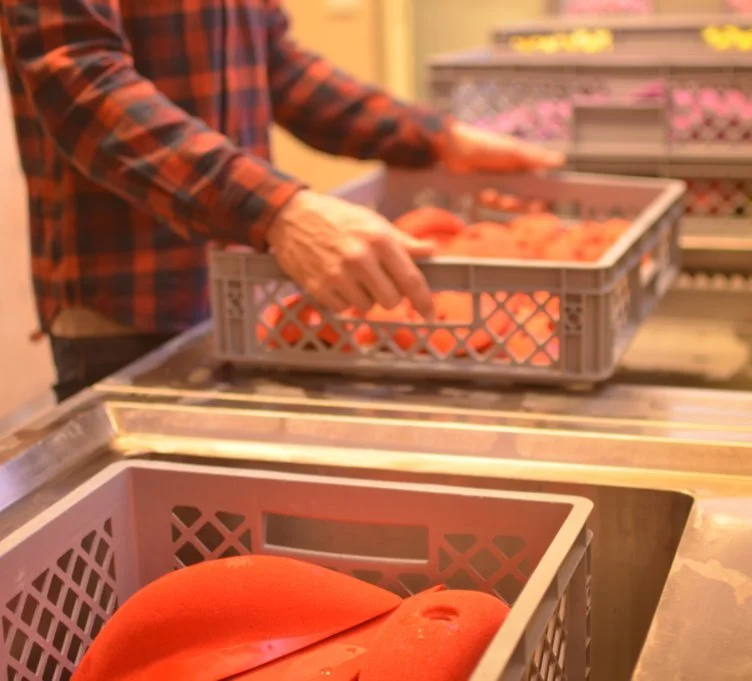
The biggest time-sink in cleaning holds isn’t the washing itself, it’s moving holds around between steps. Think of it like a dishwasher: the tray goes in dirty, moves through each stage, and comes out clean. The tray never changes. Treat your holds the same way: one crate per hold batch, and the crate moves through the process, not the holds.
1
Loosen the chalk before scrubbing. Let the chemistry do some work so you don’t have to.
2
The main cleaning step — brush, soak, dishwasher, or ultrasonic depending on your setup.
3
Remove all detergent residue. Soap left on holds makes them slippery and attracts dirt faster.
4
The step everyone underestimates. Holds must be bone dry before going back on the wall.
On drying: wet holds put back on the wall attract chalk faster, feel worse to climb on, and can cause wooden board panels to absorb moisture over time. A drying rack with good airflow, even just a small fan, makes a significant difference.
Home wall checklist
- Batch holds by size before you start
- Pre-soak in diluted vinegar, then soak in dish soap water (20 min)
- Scrub each hold with a stiff brush
- Rinse under running water
- Lay flat on a towel or rack with a fan
- Wait until completely dry before reinstalling
Commercial gym checklist
- One crate per batch — holds go in dirty and don't come out until dry
- Move each crate to the wash station — holds stay in the crate throughout
- Rinse in place, then move the crate to the drying rack
- Holds dry in the crate — no individual handling between steps
- Never put holds back damp — ever
How often should climbing holds be cleaned?
It depends on volume. For commercial gyms with high daily usage, holds on active routes should be cleaned every 4–8 weeks — or whenever a route comes down. For small gyms and home walls, every 2–3 months is typically fine if you’re climbing regularly.
The practical signal is feel, not a calendar: when holds start to feel slick rather than textured, or you can see a grey-white chalk film building up in the creases, it’s time. Rubber residue is less visible but builds up faster on foot-heavy problems — that smooth, almost polished feel is a reliable indicator.
Can I put climbing holds in the dishwasher?
Yes, for standard resin and polyurethane holds — with a few conditions. Remove any T-nuts or bolts first. Use a low-temperature programme (40–50°C), no heat-dry cycle, and a small amount of mild detergent. The dishwasher handles chalk and biological matter well and the holds come out dry, which is a genuine advantage.
Avoid wooden holds, holds with decorative paint or soft urethane surfaces that might warp, and any holds with metal components that could corrode. It also won’t remove rubber residue — for that, you still need physical agitation or ultrasonic cleaning.
What actually removes rubber residue from climbing holds?
This is the hard one. Rubber bonds mechanically to the hold surface — no standard detergent dissolves it. The effective options are: stiff-bristled brush scrubbing (works, but is slow and labour-intensive at scale), pressure washing at moderate distance (faster but erodes texture over time), and ultrasonic cleaning, which uses cavitation to dislodge particles without the mechanical damage of a brush or pressure washer.
Soaking, vinegar spray, and standard dish soap all leave rubber residue completely untouched. If your holds feel smooth and slippery after a routine wash, rubber is almost certainly the cause.
Is vinegar safe to use on climbing holds?
Yes. White vinegar diluted 1:3 with water is safe for standard polyurethane and resin holds and is particularly effective at dissolving chalk — because chalk is alkaline and acetic acid neutralises it directly. Rinse thoroughly after.
Do not use undiluted vinegar repeatedly over a long period, and avoid it on holds with painted or decorated surfaces that might lift. It does nothing for rubber residue and only partially addresses biological matter — for a complete clean, follow up with dish soap and a scrub.
Can I use bleach to clean climbing holds?
No. Bleach (sodium hypochlorite) is too aggressive for climbing holds. It degrades polyurethane over time — making holds brittle, discoloured, and prone to cracking — and it does nothing useful that a mild detergent and vinegar combination doesn’t already do more safely.
The instinct makes sense: bleach feels like a deep clean. But climbing holds are not a food-prep surface. The goal is removing chalk, biological matter, and rubber residue — not sterilisation. Dish soap handles the biology. Vinegar handles the chalk. Neither will ruin a hold.
How long do climbing holds take to dry?
Longer than most people expect. Air-drying at room temperature with no airflow: 4–8 hours depending on hold size and ambient humidity. With a fan blowing directly on them: 2–4 hours. Macro volumes and foot holds with deep pockets take the longest — moisture hides in recesses that look dry on the outside.
The only reliable test is touch: if any part feels cool or damp, it’s not ready. Wet holds put back on the wall attract chalk faster, feel worse, and can cause moisture damage to wooden board panels over time. Drying is the step that gets skipped most often, and it’s the one that matters most.
What detergent should I use to clean climbing holds?
Standard dish soap in warm water is the right answer for most situations — it breaks down oils and biological matter effectively without any risk to the hold material. For chalk, a diluted white vinegar solution (1:3 with water) works better because the acid neutralises the alkaline mineral directly.
Avoid bleach, strong alkaline degreasers, solvent-based cleaners, and anything labelled for industrial use unless you’ve confirmed it’s compatible with polyurethane. The goal is clean holds, not sterile lab equipment — mild and consistent beats harsh and occasional every time.
What's the fastest way to clean a large number of climbing holds?
The bottleneck at scale isn’t the washing — it’s the handling. Moving holds between containers, scrubbing individually, and waiting for them to dry all compound fast when you’re dealing with 200+ holds. The biggest efficiency gains come from a crate-based workflow where holds stay in the same container through every stage, and from a method that doesn’t require individual scrubbing.
Ultrasonic cleaning systems address both: holds go in dirty, cavitation does the mechanical work without manual scrubbing, and volume throughput is consistent regardless of how dirty the holds are. For gyms doing regular resets, the time saving over the course of a year is substantial.
References & further reading
Magnesium carbonate (chalk) chemistry: Mg(OH)₂ + CO₂ → MgCO₃ — alkaline mineral salt, pH ~10. Soluble in dilute acids including acetic acid (vinegar).
Mason, T.J. (1990). Sonochemistry: The Uses of Ultrasound in Chemistry. Royal Society of Chemistry — foundational reference on acoustic cavitation in cleaning applications.
Neppiras, E.A. (1980). Acoustic cavitation. Physics Reports, 61(3), 159–251 — mechanism behind particle removal in ultrasonic cleaning.
Polyurethane degradation: manufacturer guidance from Kilter, Teknik, and Pusher holds on cleaning product compatibility. General consensus: avoid oxidising agents (bleach, peroxide) and strong alkaline cleaners above pH 10.
White vinegar: 5% acetic acid solution, pH ~2.5–3.0. Safe for polyurethane at recommended dilutions (1:3 with water). MSDS: acetic acid.
ISO 4521 and related industrial ultrasonic cleaning standards — process validation for cavitation-based surface cleaning.
European Cleaning Journal — guidance on hygiene standards in shared athletic equipment and recreational facilities.